When gear breakage occurs in a pump, the first explanation that often comes to mind is a component defect or excessively demanding operating conditions. Indeed, even a robust pump can fail when subjected to excessive loads.
This is what happens, for example, in the case of a V-shaped rupture in the pump body.
However, the problem is not always caused by a load beyond what the component can withstand. In some cases, the cause is precisely the opposite: very low operating pressure.
This was the situation faced by one of our customers, a company that manufactures high-pressure multi-stage reciprocating compressors, which contacted us about an issue with some Vivoil pumps.
Pumps failing shortly after entering service
In their standard configuration, our customer’s compressors are fully splash-lubricated: the crankshaft, as it rotates, dips into the oil in the crankcase and sprays it onto the cylinder liners.
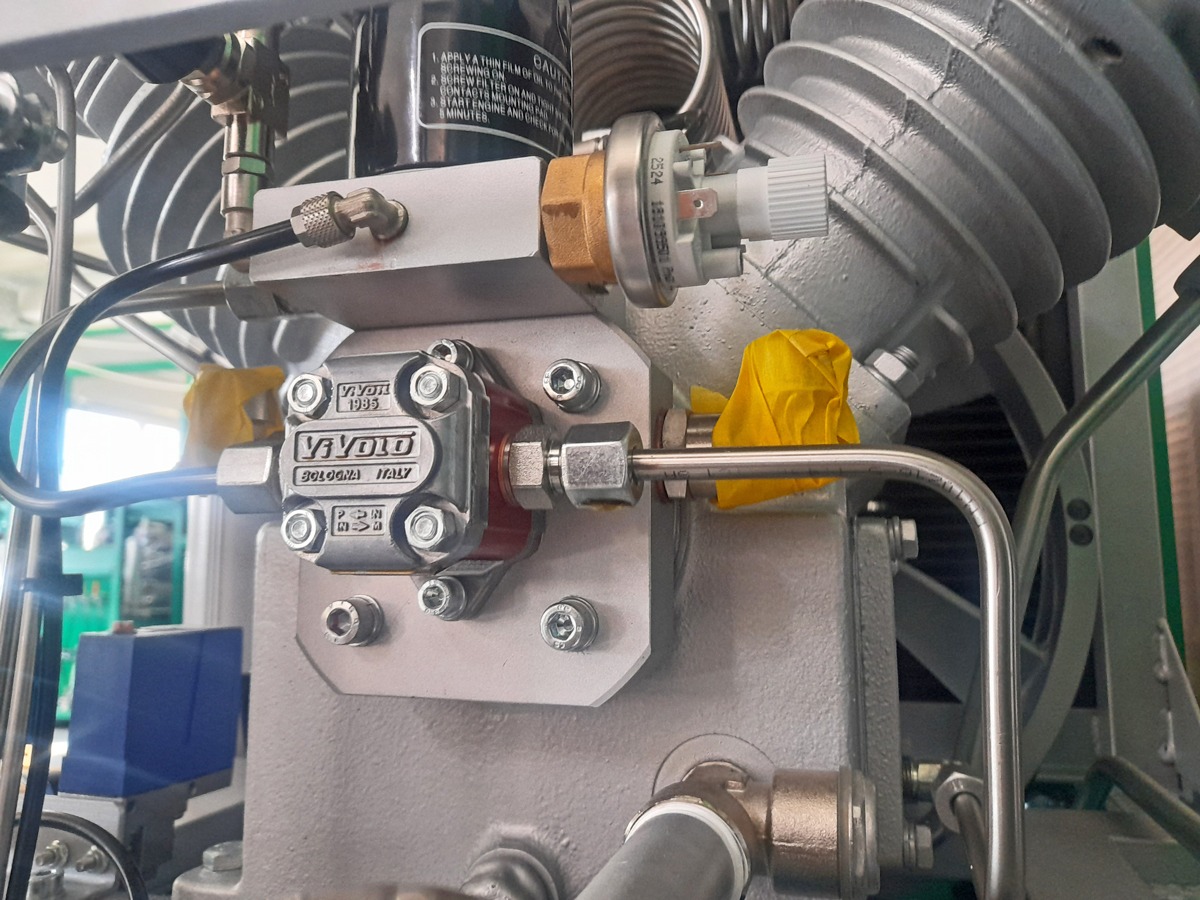
In addition to this configuration, the customer also offers an optional version equipped with a hydraulic gear pump, which draws oil from the crankcase and delivers it to the liner of the final stage, the most difficult point to lubricate. In this version, the circuit also includes an aftercooler, a cleaning filter and a pressure switch that stops the engine when the oil runs out.
The issue reported by the customer concerned the components in this alternative configuration: the Vivoil pumps installed had a displacement of 0.17 cm³/rev (the smallest in our range), were in perfect working order and correctly sized for the circuit, but shortly after entering service they had failed due to gear breakage.
Here is what our engineering team discovered.
Operating pressure was the problem
To identify the cause of the issue, we examined the application’s technical data and noticed something we had not initially known: the pumps were operating at very low pressures, under 5 bar. When our components are ordered, we do not always receive a detailed description of their intended use.
This was significant because standard Vivoil pumps are tested to operate at 250-300 bar. Our engineering team therefore suspected that the gear breakage was directly linked to the operating conditions.
Why can excessively low pressure damage a pump?
In our standard pumps, the bushings are intentionally tightly packed. High fluid pressure causes them to separate slightly, allowing the rotating components to move freely under normal working conditions.
However, when the pressure is very low and the pump has a small displacement, as in this case (0.17 cm³/rev), this separation does not occur.
The gears then run with excessive friction, which can cause them to fail.
The solution: a customized low-friction pump
Once we had identified the most likely cause of the issue, we developed a special low-friction version of the pump, better suited to low-pressure applications, and suggested that the customer try it. Here are its specifications:
- Model: 7P0101001 (standard model code: X0P0101ABBA)
- Type: unidirectional pump
- Size group: 0
- Displacement: 0.17 cm³/rev
Unlike other cases, in which we designed, prototyped and manufactured a custom component, this time there was no need to start from scratch. We customized one of our standard models, removing the internal compensation section of the seal, the element that normally keeps the bushings tightly packed.
Without this section, the bushings remain slightly separated, allowing the gears to rotate freely even when the fluid pressure is very low.
The customer successfully tested the new pumps and confirmed that the issue had been permanently resolved.
Sharing the operating conditions is always helpful
This case study shows that even a component that works properly and is correctly sized can still be damaged if it operates under conditions other than those for which it was designed.
Here is our advice: when choosing a pump for your application, we recommend telling your supplier the actual operating conditions, such as the working pressure, especially when it differs significantly from standard values.
At Vivoil, we can help you assess whether the component is suitable for the use you have in mind and, if necessary, suggest a custom alternative, either designed from scratch or developed by customizing one of our standard models.
Contact us. We are here to help you find the best component for your project.